

While reporting on the location of seven airstrikes across three cities and over a year and a half of gathering information, a collective of 75 people have been killed and 396 people injured in just these seven attacks. This is not the total number of people killed or injured at this time, but rather a small snapshot of a topic so broad that it requires multiple viewpoints to truly comprehend.
In this three-part series I will be showing multiple perspectives and responses to airstrikes from those of civilians on the ground, journalists on the scene, the DSNS firefighters who have faced frontline conditions, and even exclusive access inside the Kharkiv command and coordination center.
Today is the experience of reporting on multiple strikes around Ukraine through the eyes of reporters on civilians.
Odesa under fire
Since the start of 2025, Russia has launched a total of 28,597 drones against Ukraine. Russia has destroyed over 200,000 homes, adding to the more than 1.4 million households that have been either damaged or destroyed—this directly affects over 3.4 million people. With a reported 90% of Russian missiles, drones, and bombs hitting civilian targets, these disaster sites become so frequent that they become commonplace. It can border on routine and “old news” for some, but this disengagement leads people to look away from the horrors that millions face on a daily basis and causes many in the Western media to stop paying attention to these tragedies.
There is a phrase here in Ukraine that has replaced the standard “Good night” or “See you tomorrow,” which is “Have a quiet night.” I almost did on July 3rd, 2025, whilst in the Odesa countryside. I had stayed up all night with the men of the 11th National Guard, based out of Odesa. Stationed on a sea cliff overlooking the Black Sea far from the city, I was there to document their work; however, Vitaly, a soldier in the unit, would tell me, “We’ve had more days off than days on recently.” He and his unit played a group game on their phones as the night passed.
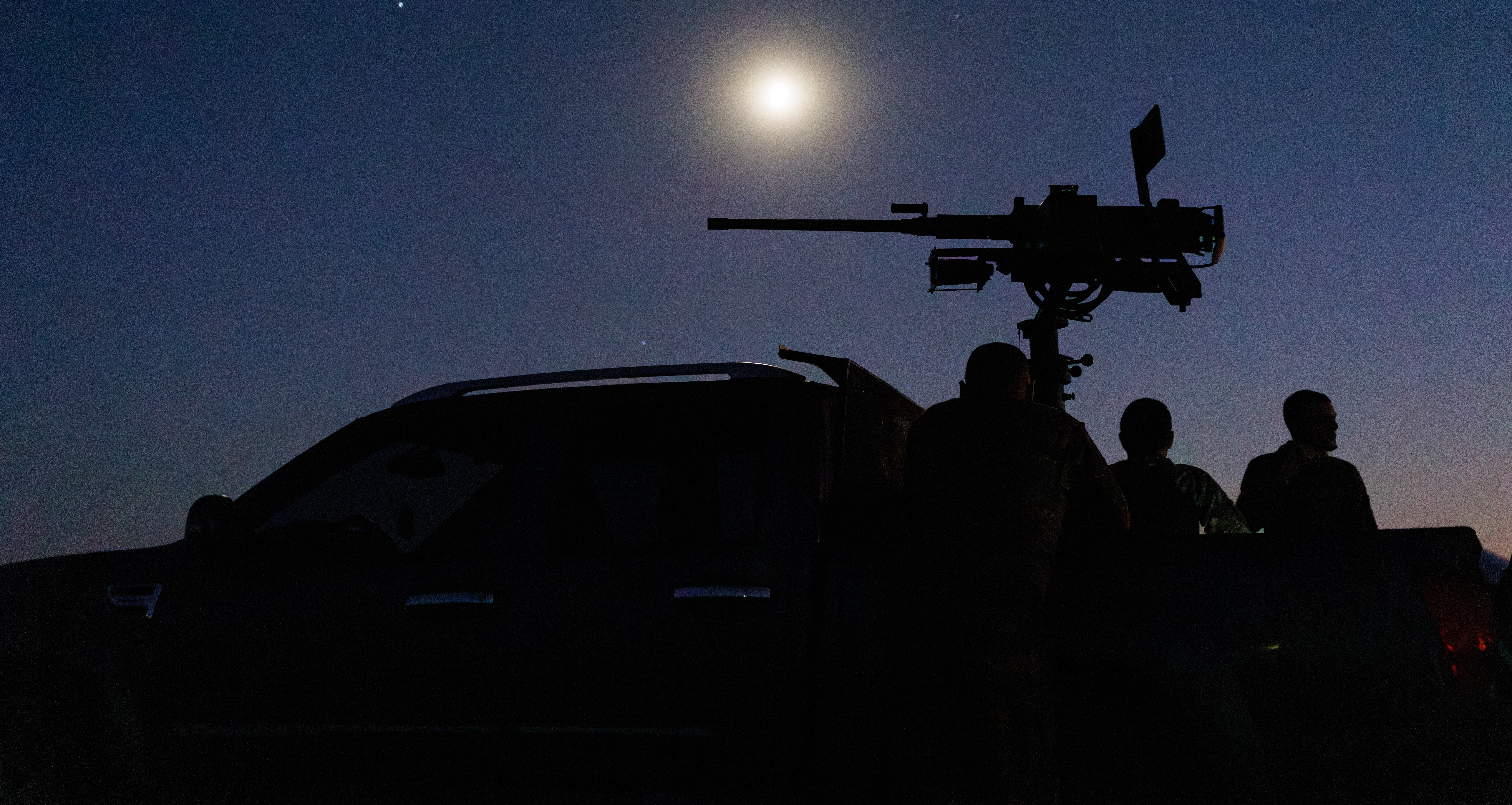
The Russians have found that traversing their drones over the water or violating Moldovan airspace has allowed them to strike at Odesa with greater efficiency, bypassing land-based air defense operations entirely. With 90% of Russian aerial attacks committed against civilian targets, anti-aircraft operations have long stood as the shield protecting a somewhat normal life in major cities across Ukraine. This does make them quite the target, though. A pattern that only shines more true in speaking with multiple anti-aircraft teams across Ukraine, from the 113th Separate Territorial Defense Brigade, the Ukrainian Navy, and even this National Guard unit.
By the time 2am rolled around, it was looking as if no drones would cross this mobile anti-aircraft team’s range, although a few were flying towards the city. And by the time I arrived back in Odesa, drones were already there above the city, and anti-aircraft tracer rounds danced through the sky. The danger was not with the military embed but rather within the city, it seemed. A civilian building had been hit.
Speeding through the city, following the fire trucks and the smell of smoke, I see fire come into view. Sprinting from the car to the sounds of crackling flame and falling glass, I get a front-row seat to the results of this attack: A nine-story civilian building with an inferno raging on both sides of the impact zone. Just before my arrival, a woman had been captured on video screaming out of one of the apartments: “Do something! I don’t want to die!”

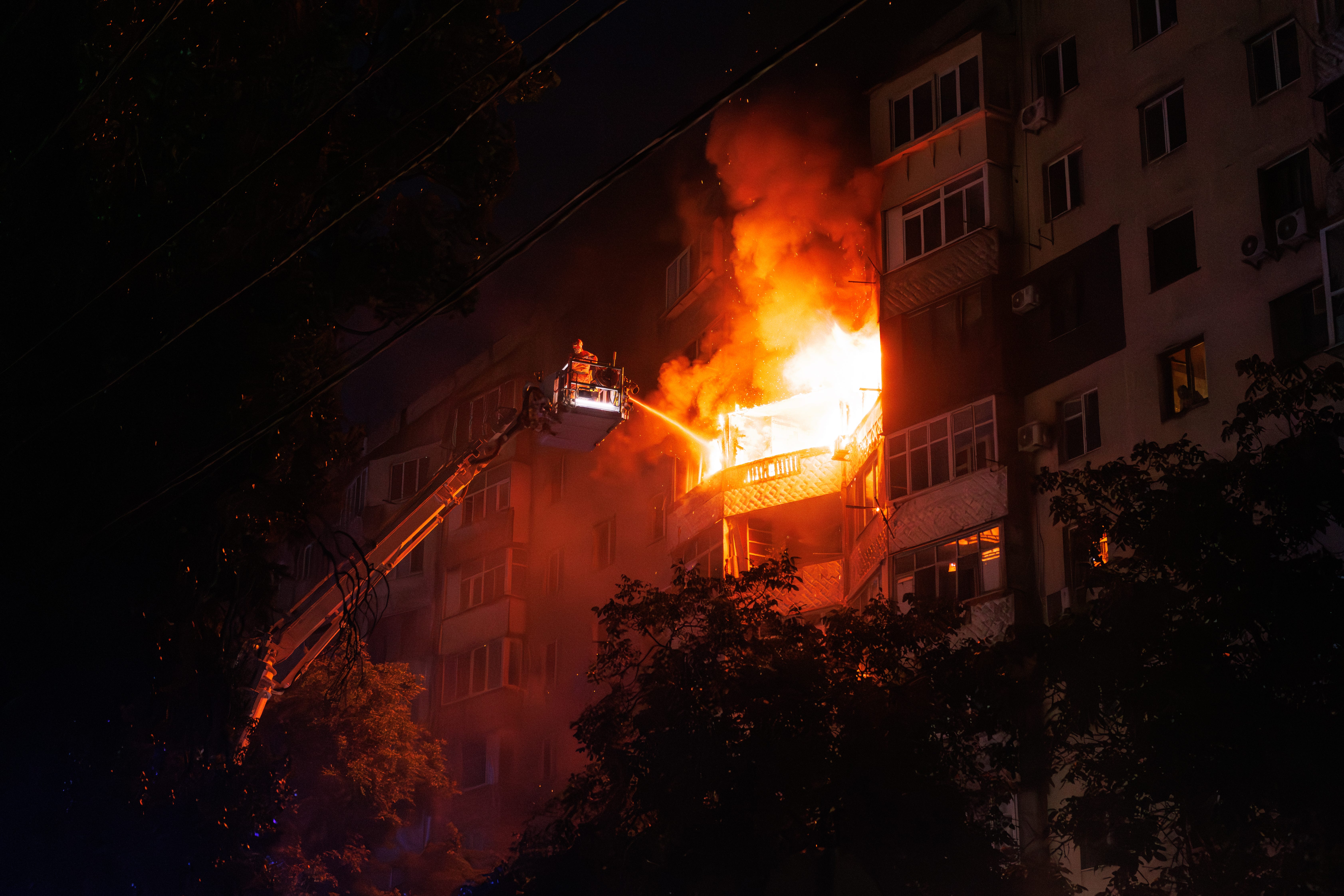
A Shahed drone punched a hole straight through the building with its impact, causing the older-built apartment block to crumble and catch fire quickly. Emergency responders quickly couple hoses and talk into handheld radios. Medical crews, firefighters, men in body armor, and civilian aid organizations race around to deal with the situation at hand.
A Shahed-131 drone is not a small thing; it is a nearly 300 lb (136 kg) drone with a wingspan of 7 feet (2.1 m) and a height of over 8 feet (2.6 m). These are the smallest versions seen in attacks like this. The larger Shahed-136 drones weigh a whopping 440 lb (200 kg) and have a much longer range. Both are considered cheap and easy ways to conduct these mass strikes, as they can overwhelm anti-air teams with sheer numbers.
Shahed drones are preprogrammed with geocoordinates before being sent off. That means there is a person typing in precise coordinates that the Shahed-series drone will use before the engines even start to spin up. Hits into civilian buildings are often seen as tragic accidents by those who don’t know this or the fact that these drones can carry out complex maneuvers and directional changes mid-flight. Sometimes a person is targeted an hour or more before the drone slams into them, and they would never know until impact.
Searchlights scan across the building as water is sprayed into the fire, causing mist and smoke to fill the air. Civilians await below in this dense, uncomfortable air; some wait for words of their loved ones, others watch as their apartment gets caught up in the flame and spray. Search teams on the ground call out, and the basket of the fire crew’s aerial platform slowly swings to the apartment just to the top left of the fiery hole. Rescue workers enter the damaged building just to come back out with a woman and two children wrapped in a blanket. With soot covering their bodies, one boy is fine as the other is quickly carried over to medical teams on-site as their family surrounds them.
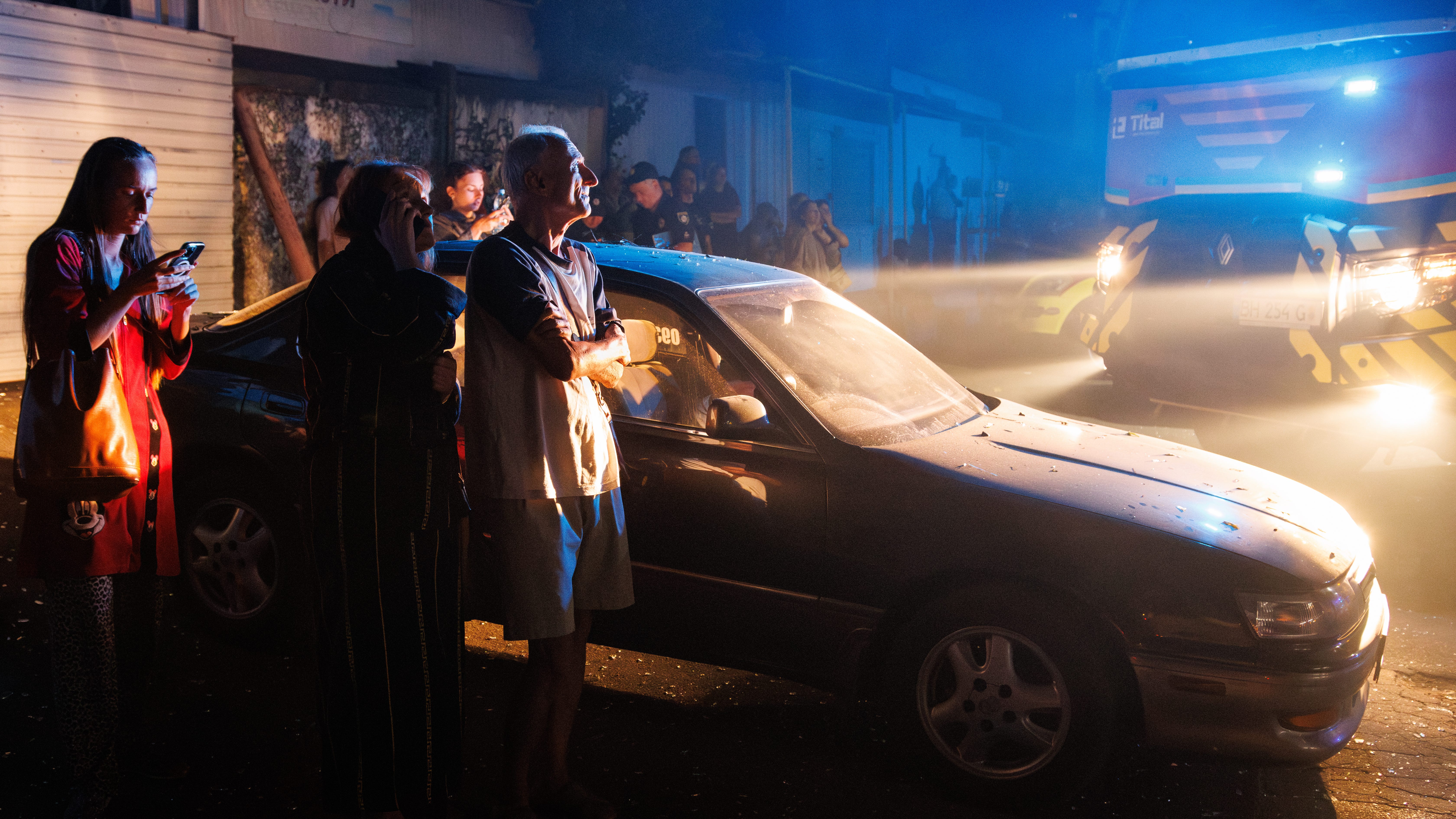
As 5am rolled around, the fire was still burning, but the forensic teams began to gather the bits and pieces of debris, and those providing civilians with coffee and tea were now in full force. I walked back to the car mentally exhausted. This was not the first strike that I had covered on the ground, and it would be far from the last.
Mobile Rescue Center
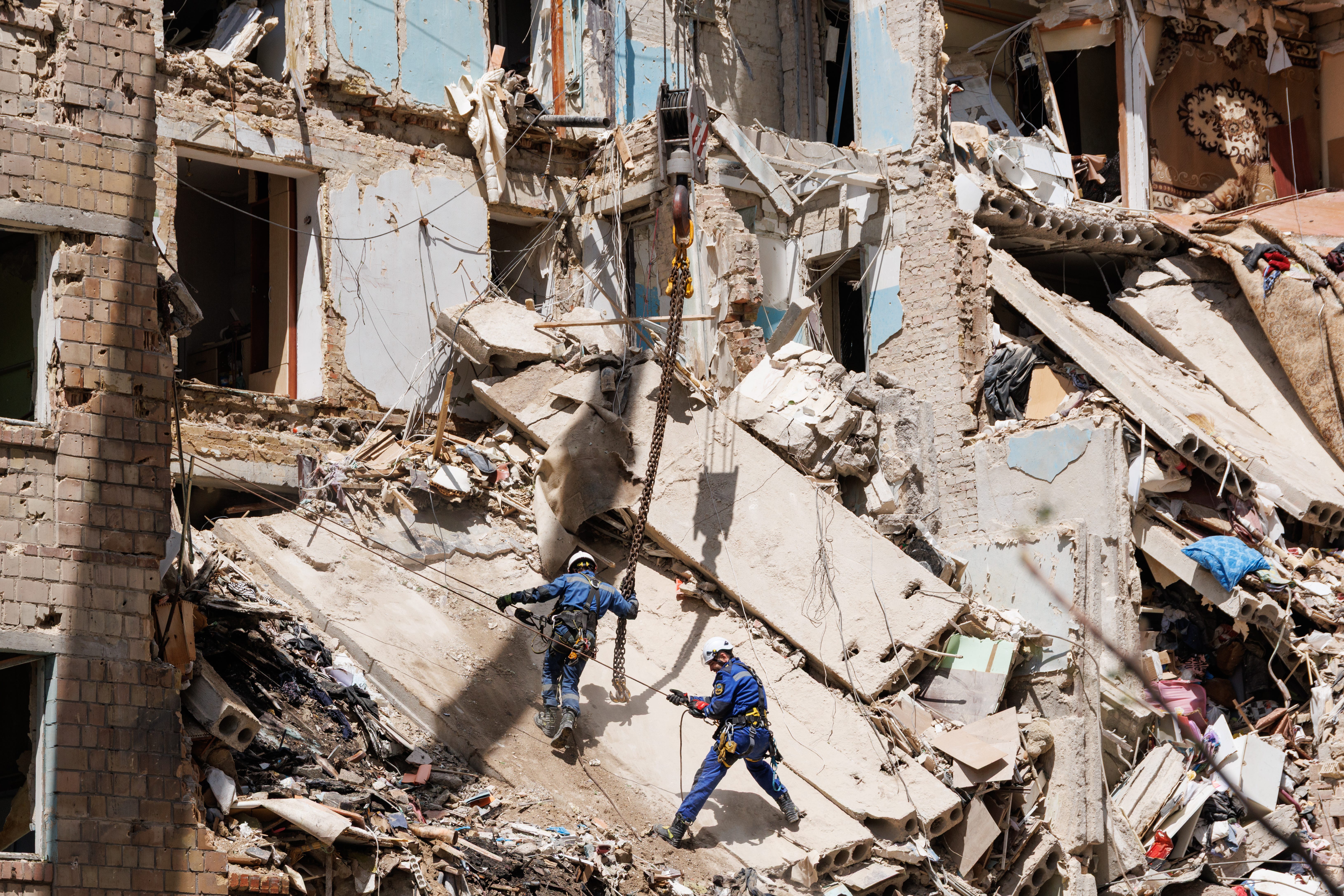
Missile strikes are markedly different from those of Shahed drones. Missiles provide less warning, have higher payloads, are more precise, are harder and more costly for anti-air teams to shoot down, and are often far deadlier when striking civilian targets. The attack on June 23rd was just one of these missile attacks. Confirmed to me by a source on the ground, a North Korean Hwasong-11A struck directly into a civilian apartment building that is just a kilometer away from the U.S. embassy in Kyiv, the nation’s capital.
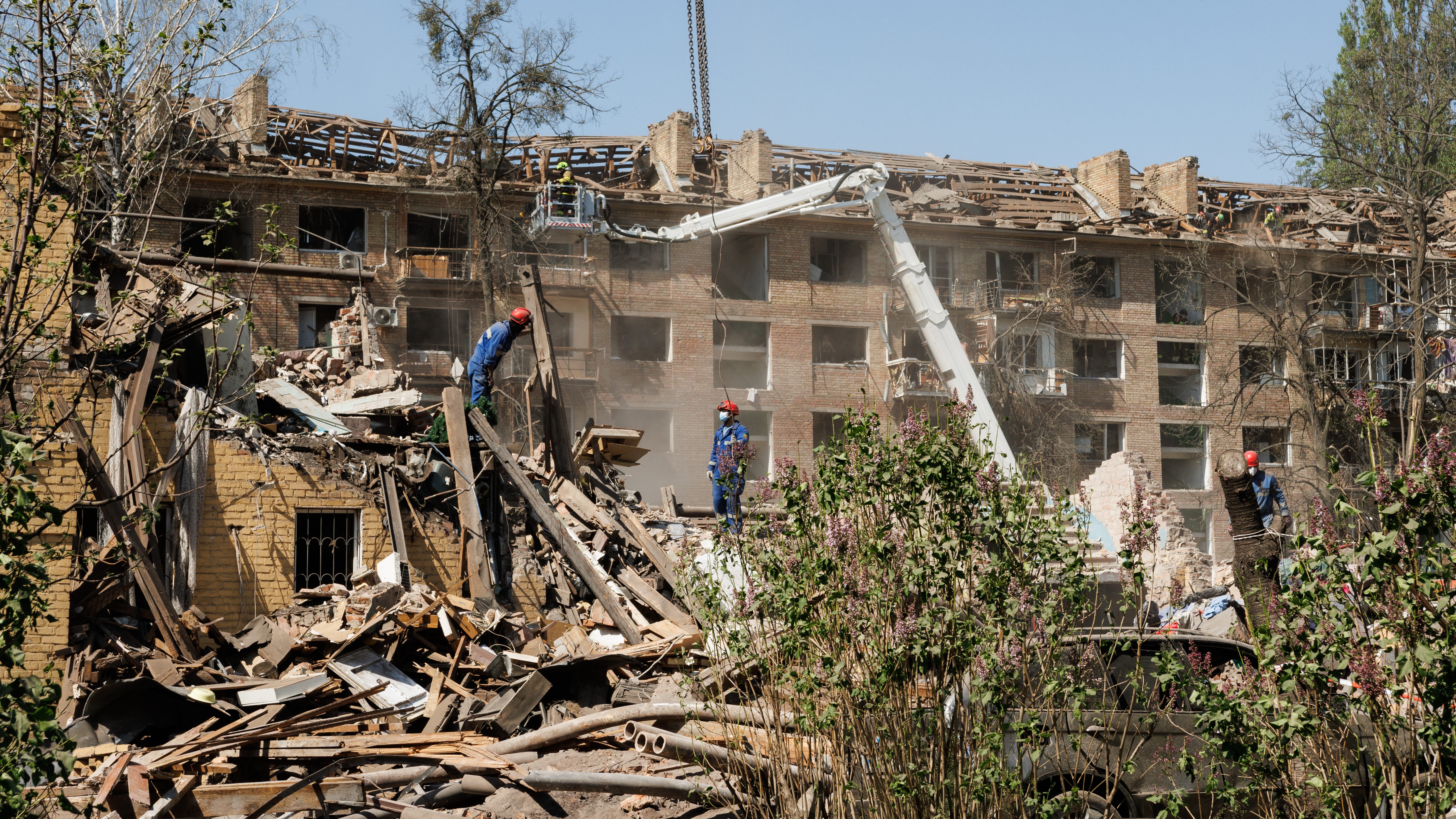
A week prior, on June 17th, a Russian missile had hit a civilian high-rise just a ten-minute walk from this position; that strike would see that building nearly split in two. That was a week ago though, today though, I stood in the courtyard of this building that is now torn up by the tires of emergency service vehicles, debris from the collapse, and the burned remains of trees. Concrete dust and asbestos filled the air, old construction methods still affecting those working to clear the rubble and find survivors or bodies.
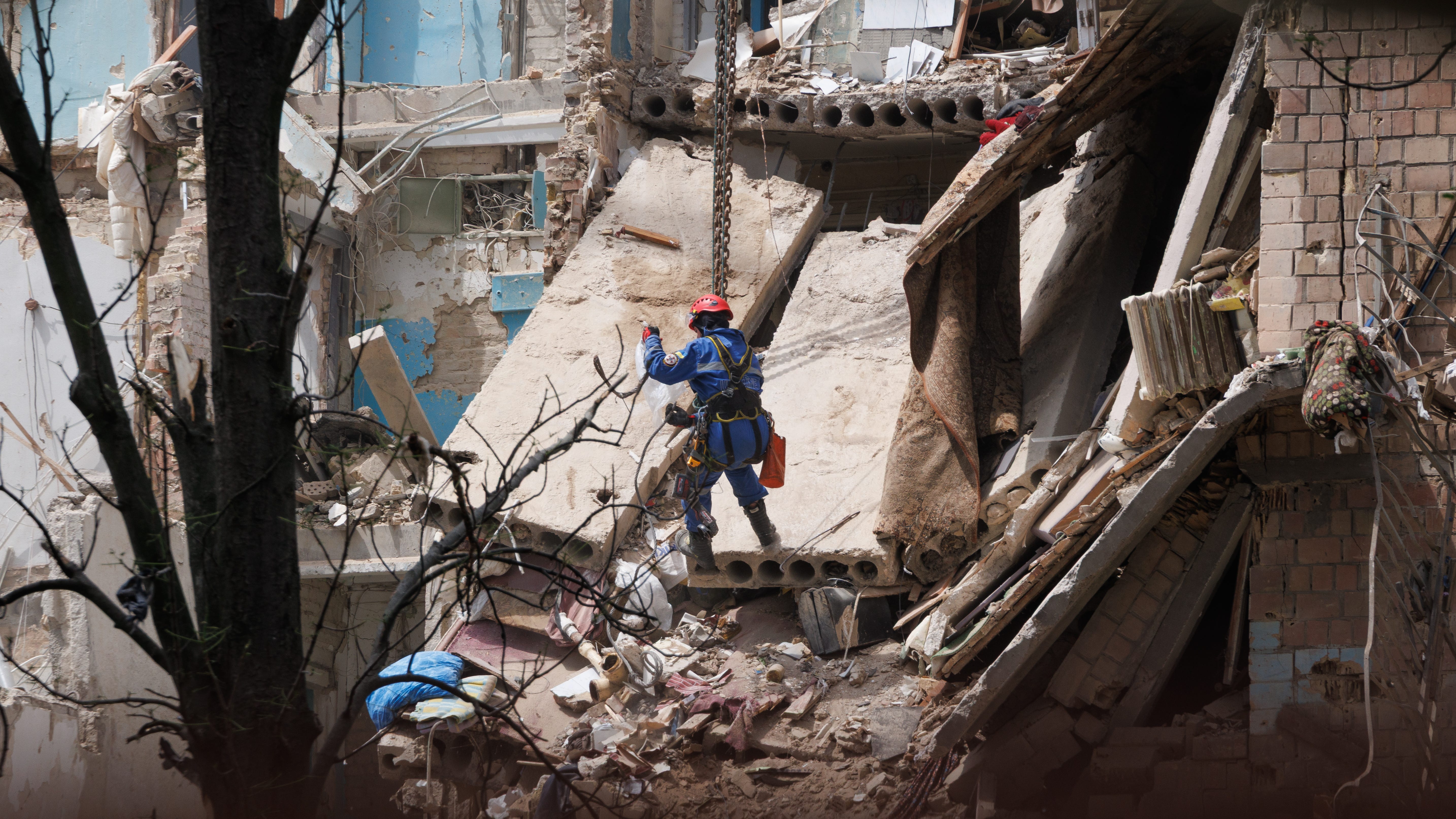
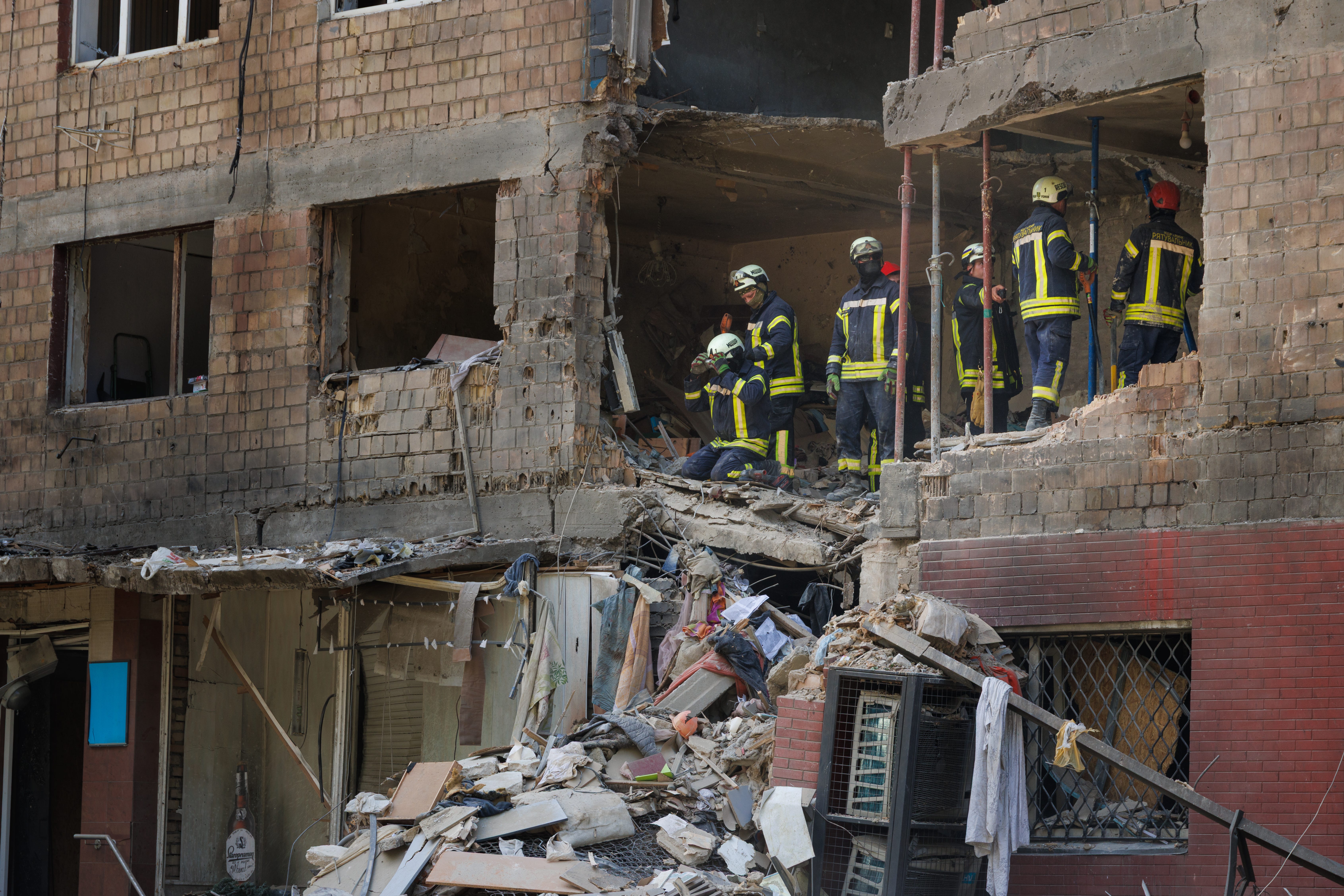
Six stories collapsed in on themselves from the direct impact, and working to find people or bodies trapped under this rubble was a team of DSNS specialists—the Mobile Recuse Center. In their dusty blue jumpsuits they work around the clock, sometimes 24-hour or longer shifts, to clear bodies, find those buried in rubble, recover lost items, and clear a site to make it as safe as possible. This same unit was deployed to the Chornobyl Nuclear Power Plant to extinguish the flame caused by a Russian drone hitting the infamous nuclear reactor’s sarcophagus on February 14th, 2025. Considered DSNS’s most elite units, their skills found new purpose when the full-scale invasion began. Though this comes at a cost, due to the massive increase in attacks on civilian infrastructure here in Kyiv, there is more need for search and rescue teams, and when asked about when they have time off, all I got in response was a laugh.
Repelling down from a crane, members of the Mobile Rescue Center start attaching anchor points to a large slab of concrete that collapsed over the remaining debris. Hoisting up the concrete slab reveals the shattered remains of an apartment—a life that had been built over the years is now nothing more than ruins. It is soon announced that they have found a person.
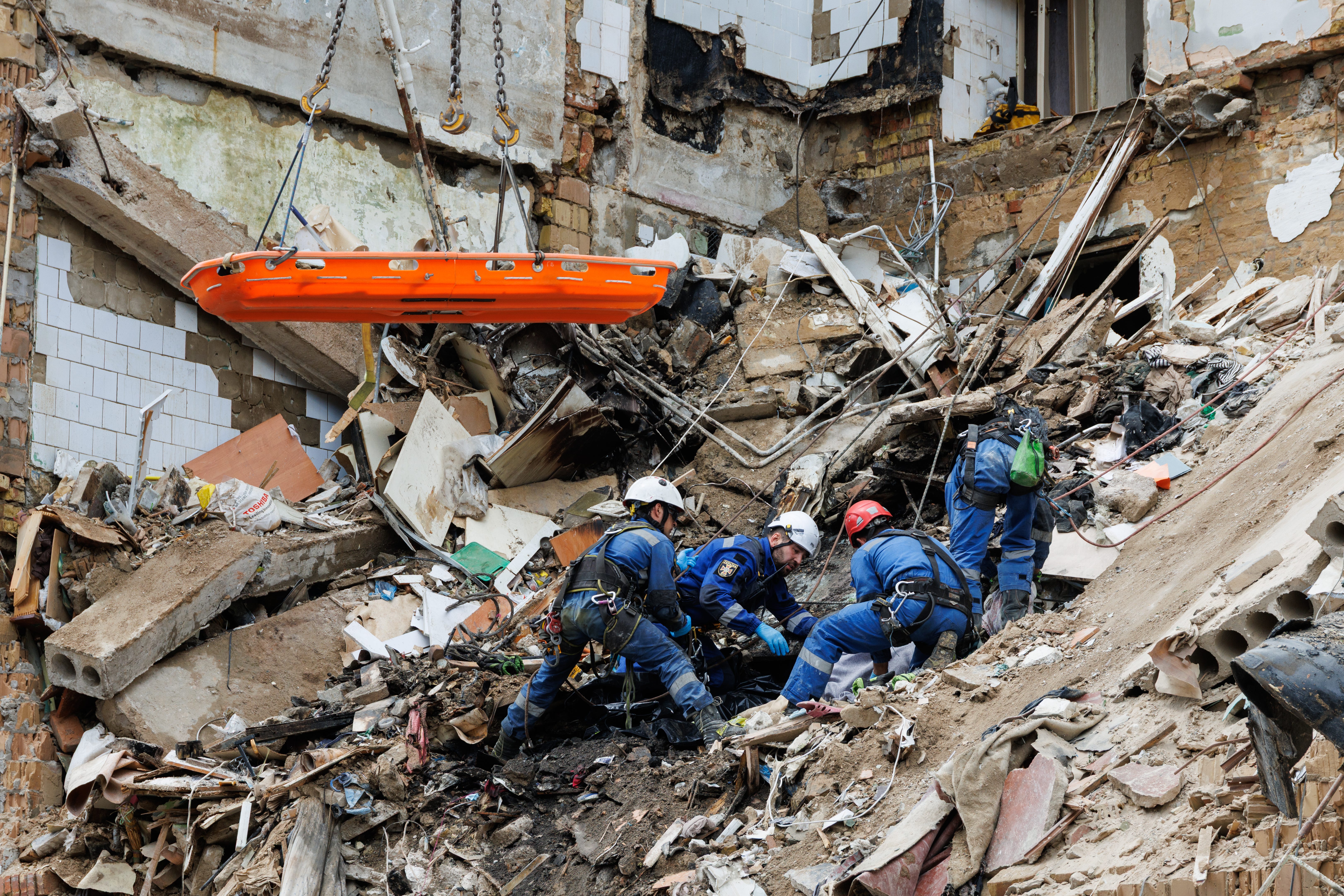
Removing the rubble that killed them, the unit lifts up and places the body onto a gurney, the 7th confined dead on that day— though the number would later be increased to 9. Both the deceased and the unit would come down from the building. Seven of them would act as the initial pallbearers to carry this person off-site and one step closer to their final resting place.
Burn out
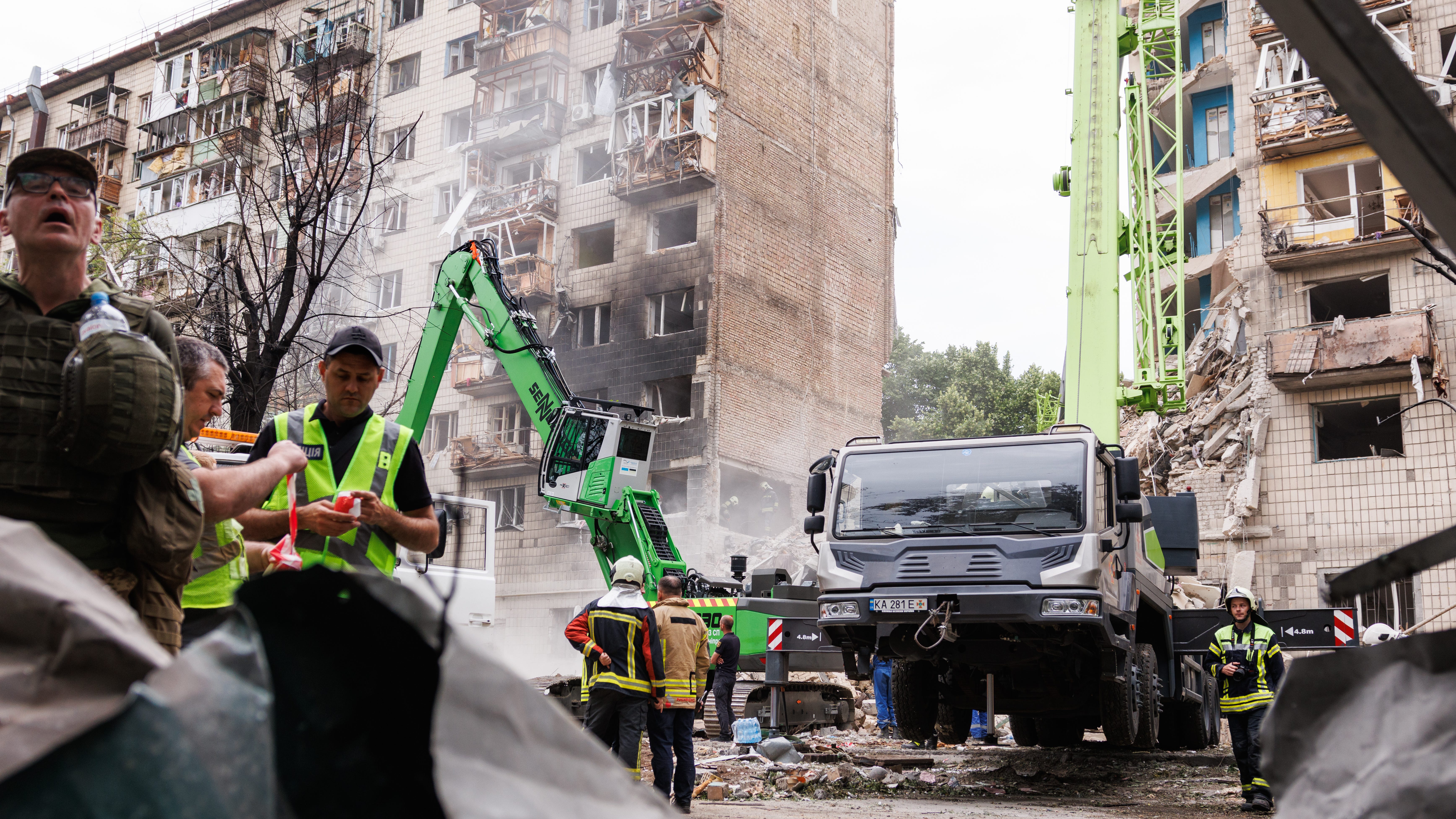
Having been to the vast majority of attacks over the last few months in Kyiv, it becomes part of your weekly routine. It is routine to arrive on-site and smell the distinctive smell of burnt memories and fine concrete dust, and it’s routine to see people who have lost everything watching what little they have left be disassembled without a clue of what tomorrow brings.
Many journalists may find themselves disconnecting from the humanity of the situations they find themselves reporting on to a degree just to do their job effectively. “I think what’s kind of interesting for me is actually how much I’m able to, I guess, sort of unfortunately, disassociate from some of the individuals that are impacted by these strikes,” said Jeremy Dirac, deputy head of News at Kyiv Post. Jeremy continued, “Because for every one of these that you see, there’s real tragedy that’s happening. I think it was the first one that we had gone to together. They had been waiting all day for their son to hopefully be okay. And it turned out that he wasn’t okay. He didn’t make it out of that. I hope that... I’m glad to be, you know, doing this work. I think it’s so easy for people to lose sight of what’s happening here.”
I am frequently joined on location by Jeremy and Corrie Nieto, the lead video reporter for EuroMaidan Press.”To me it’s so surprising how commonplace it’s become. It feels like there’s been five attacks, you know, one every week, and we’ve been to maybe like the last three or four, like all of us together. Sure, we hang out besides this, but it’s so wild to me that this is like one of our meetup places these days,” Corrie would reflect with me as we packed our camera equipment and made our way to our usual co-working space.
Many civilians who in 23’ or 24’ may have found themselves growing apathetic to the threat of airstrikes are now themselves sleeping in the Metro once again, taking the advice of having two walls between you to brace any potential impact, and checking the Telegram channels with more frequency. On one partially loud night, Corrie would tell me, “It was so scary. Last night was the first time I was actually in the shelter. It was so loud. I heard the ballistic missiles go off, shahed drones flying above. It’s such a surreal thing. But in Ukraine, especially in Kyiv these days, it’s become normal, right? It’s not supposed to be normal. It’s fucking crazy.”
As mentioned earlier, from January to July of 2025, Russia launched a total of 28,597 drones against Ukraine, double the previous year. News is only news when it comes rarely, right?
Despite whoever is paying attention, these are the everyday experiences of those who live in Ukraine. Parents rushing their children into metro stations in the middle of the night, couples holding hands in their beds hoping the attack will spare them, children’s cancer hospitals bombed into oblivion, a train full of women and children in Dnipro that was struck by the blast of a missile, the terror campaign of sending imprecise KAB aerial bombs to attack Kharkiv in late 2023 and the majority of 2024, and the woman in Odesa screaming for her life—hoping she did not burn alive.
The rare luxury of a quite night
The skies above Kyiv had become quiet again over the month of August 2025, this not met with any relief, though, just suspicion about what could be a very loud autumn. A suspicion that has proven true as on September 7th, 2025 a new record of over 800 drones were launched against Ukraine Though what can be done in everyday life? Shops stay open, people go to sleep tired, and coffee shop owners wheel out their espresso machines to serve their community even if their storefront is no more. What is often said in the West as “Ukrainian resilience” is simply people needing to get on with their lives despite the circumstances. True resilience is experiencing all this and still getting up to fight for the dream of a better world—as is the case with the majority of Ukrainians.
On July 20th, just 10 days after I was on-site of a Geran-2 attack in the Shevchenkivskyi district of Kyiv, Russian state-owned media published a video of the secretive Yelabuga Plant near Kazan, in the Tatarstan region of Russia. Using teenage workers, this plant produces the Geran-2 drones—the Russian domestically produced version of the infamous Shahed-136 drone. Showing off a capacity to produce thousands of these drones a month, and with record-breaking numbers of drones being used against Ukraine with more and more frequency, this could lead to an escalation of terror in Ukraine, and until both the “arrow” of drones and missiles and the “archer” of strategic aircraft and drone launching sites can be adequately destroyed or stopped, there is no end in sight, no clear skies over Ukraine.
Airstikes against Kyiv have only picked up since the writing of this article into the ending months of 2026. New threats, new tactics, and new counter-measures are ever evolving and still the lack of coverage remains. In January of 2026 we released AIRSTRIKE, our documentary focused on the work documented in these article, if you wish to watch you can here:
But all the same, I wish you a quiet night.